

Our Easter Story
- Apr 18
- 2 min read
Reflection for the Third Sunday of Easter by Fr. Earl Valdez

Image from Inside the Vatican
I think many of us agree that we Filipinos learn our lessons more through narratives. Whenever we encounter a new word, we would rather see it used in a sentence so that we could understand the dictionary definition. And when we want to explain a new concept, our first reflex is to say “for example….” And it just dawned on me that when we speak of our talents and abilities, people are most likely to ask “sample nga dyan!” for both demonstration and entertainment.
We understand people through examples coming from our experience, perhaps because it is easier to put ourselves in their shoes rather than decipher what they are trying to say. And perhaps that is what happened on the road to Emmaus, when Our Lord accompanied some of the disciples who were about to walk away from Jerusalem, and hence their lives as disciples. Not only did Our Lord explain to them the meaning of the Scriptures and the prophecies, but also and more importantly, he walked with them. He accompanied them to where they were going, which culminated in one of the things that would remind them and fully explain to them what the Lord meant as they were walking: he broke bread with them and disappeared.
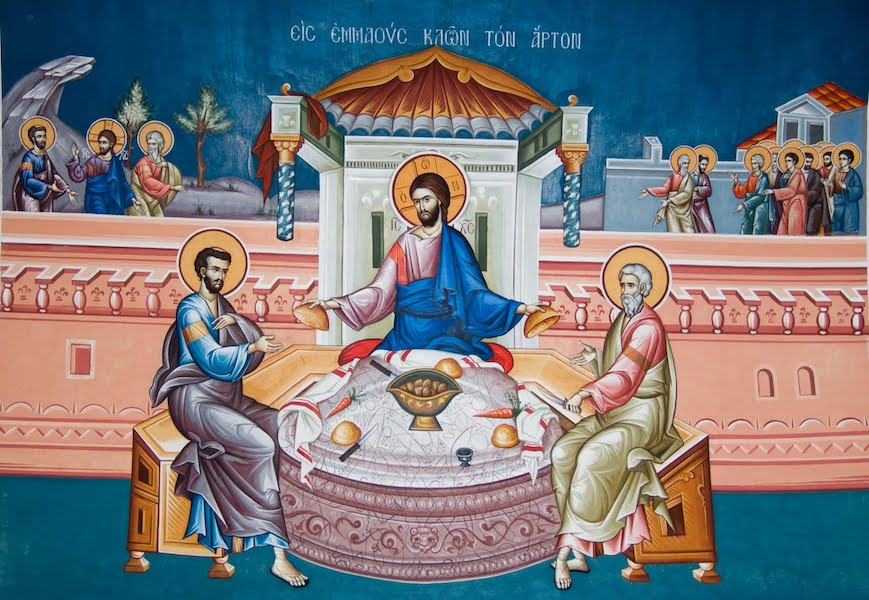
Image from Orthodox Monastery Icons
I believe that the most important moment in this resurrection episode wasn't the words spoken by the Lord as they were walking. Perhaps they were just preparatory aids for them to understand the climax of this encounter, that is, the Eucharistic meal in which they recognized the Lord as He breaks bread. The true reminder here of the Lord’s promise was in fact His willingness to walk with the disciples who were saddened, confused, and perhaps disheartened. This accompaniment led to the preaching, and then to the disciples recognizing the Resurrected Christ.
There’s a common Greek phrase for that, which has become an important term for the Church since the beginning, one that we highlight today: syn hodos. In English, it means “going together,” sharing the same path. It’s better articulated in Filipino: pakikilakbay. The Resurrected Christ not just appears; he journeys with us, walks with us, even if it takes a bit longer to recognize Him.

Image from Monastero di Bose
Thus, this long celebration of Easter is a journey toward recognizing, sharing, and proclaiming the Resurrected Lord. This also presents a “blueprint” of what the Church is and Her mission: recognizing Christ in the midst of the community, breaking bread with Him in the Eucharist, and becoming sent in mission. This is what it means to be an Easter people, and we ask for the grace that enables us to recognize Our Lord that accompanies us especially in challenging times, to break bread and share ourselves with Him as He shares Himself to us in the Eucharist, and to boldly proclaim and be witnesses to His resurrection through our own way of accompanying others who are on their way to search for the meaning of their lives.


Comments