

Where Your Heart Is
Reflection for the Thirty-Third Sunday in Ordinary Time by Fr Earl Allyson Valdez

Allegory of the Two Cities (around 15th cent.) | image from Meisterdrucke
At the end of the day, what do we actually love?
This may come as scandalous or, at the very least, disputable for many, but we believe that life is about answering that question. Centuries ago, St. Augustine already spoke about this and posed it as the fundamental direction of every human being. And as such, in every moment, each of us could not avoid this question. For him, there are only two answers to that, either (a) God, or (b) something else which is not God.
It’s a good opportunity, then, to take a moment and ask ourselves this question while looking back at what we value and hence, love. It’s not a difficult thing for us as Filipinos, because our notion of love (pagmamahal) is always connected to the question of value (mahalaga). We know that it’s worth spending time and effort for something if we love someone or something on whom we put in our effort. The things that we bought from our dear savings are those that we are sure to value and would make us happy.
But the real question is, what is truly valuable for us, enough to allow it to transform and direct our lives? We may claim to love God, but would that mean just confining Him to one area in our lives? We may claim to love our family, our friends, and other people who are special to us, but to what extent do our words truly become actions and gestures?
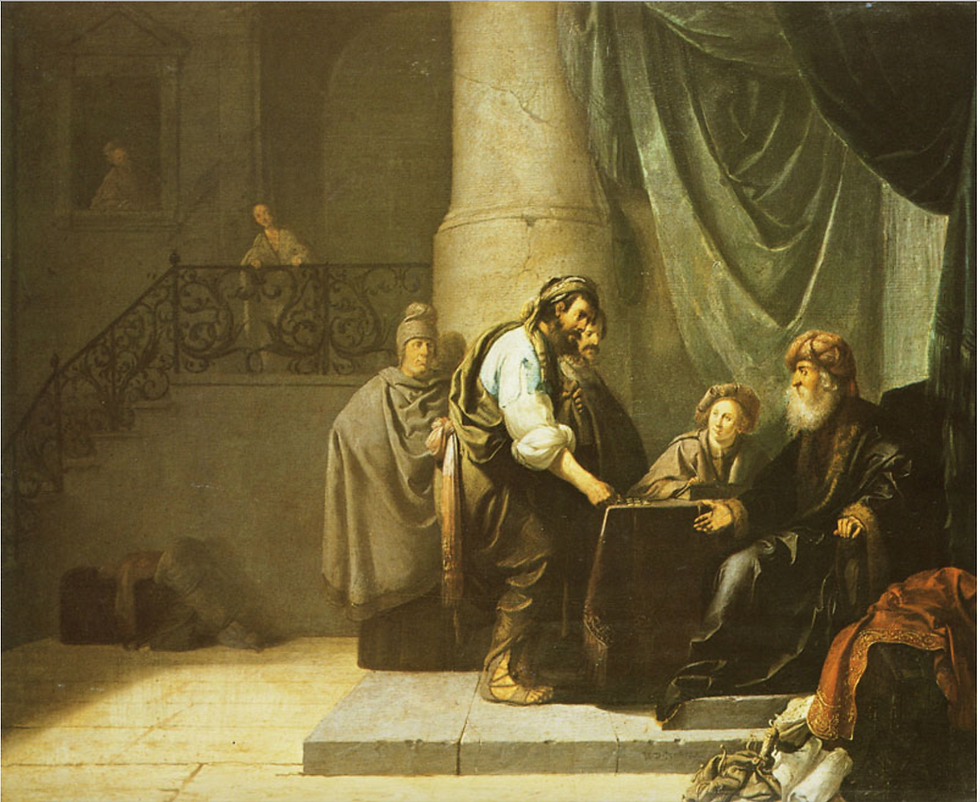
William de Poorter, “Parable of the Talents” (17th cent.) | Image from Wikimedia Commons
It is from this perspective that we ought to understand today’s readings, especially the gospel for today. The parable of the talents is not about the question of profit and productivity, though the gospel uses the image of good business sense. A deeper reality that it presents is that of the way we value whatever is entrusted to us. What was shown in what these servants did with the property that was entrusted to them was the way they valued the trust of their Master, the trust that the Master had on them, and their expectations of their own selves.
And while the first two proved themselves to have been worthy of the trust of the Master, the third one was proved to be unworthy. It is not because he was unskilled; rather, it was because he was not able to see that the Master’s trust is more important than his own need to console himself over his inability and fear. His punishment came not because his effort (or the lack of it) did not yield any gain; rather, it came because he did not value the trust of the Master over his own capacities, much more believe in them.

Fra Angelico, “The Temptation of Christ” (1441) | Image from the Catholic Magazine
The two other readings may help us understand this even more. The first reading from the book of Proverbs shows exactly what it means to seek, to find, and to be transformed by God’s love, through the image of one who values his most precious wife. This is even made even more concrete in the second reading, when St. Paul affirms our identity as “children of the Light,” with the expectation that we know who we are choosing in the end: none other than loving and following Christ. That would be the standard by which we see our lives and make decisions.
In this regard, can we then say that, between the two paths that life offers us, we orient ourselves toward the love of God? Or are there moments in which the center of our lives and our loves would be other than God?
We ask for the grace that we see, understand, and act in view of loving the God who guides us, trusts us, grants us what we need, and gives us the true meaning of our lives. Only in the eyes of one who desires to truly love God above all can receive what he has entrusted and allow it to grow twofold and threefold. We also ask for the grace to cast out all fear and hesitation that hinders us from truly loving God, which could lead us to love something other than Him. Amen.


Comments