

Body to Body
by Fr. Earl A. P. Valdez
Reflection on the Solemnity of the Body and Blood of Our Lord Jesus Christ
Dt 8:2-3, 14-16 | Ps 147 | 1 Cor 10:16-17 | Jn 6:51-58
Now more than ever, Filipinos here in Rome face the changing of the seasons, from spring to summer. The cold winds that made walking to school under the sun pleasurable, we now feel that days are becoming longer and the sunlight getting stronger. Heaters become replaced by electric fans, and the urge to take a bath comes more frequently, especially if one needs to go out of the Collegio or our relatively comfortable study hall during examination week.
I was thinking that it could have been worse in the Philippines, especially when April and May have just passed. While there are some going to beach resorts and swimming pools, there are those who suffer from heat strokes and dehydration, especially those who live in informal dwelling spaces. These are the moments that come as reminders of how we could not be separated from our own bodies, and the way we conduct and relate ourselves are always bodily in nature. But more than that, it also shows us that our bodies condition the way we think and act in the world in as much as it is the means of our self-expression.
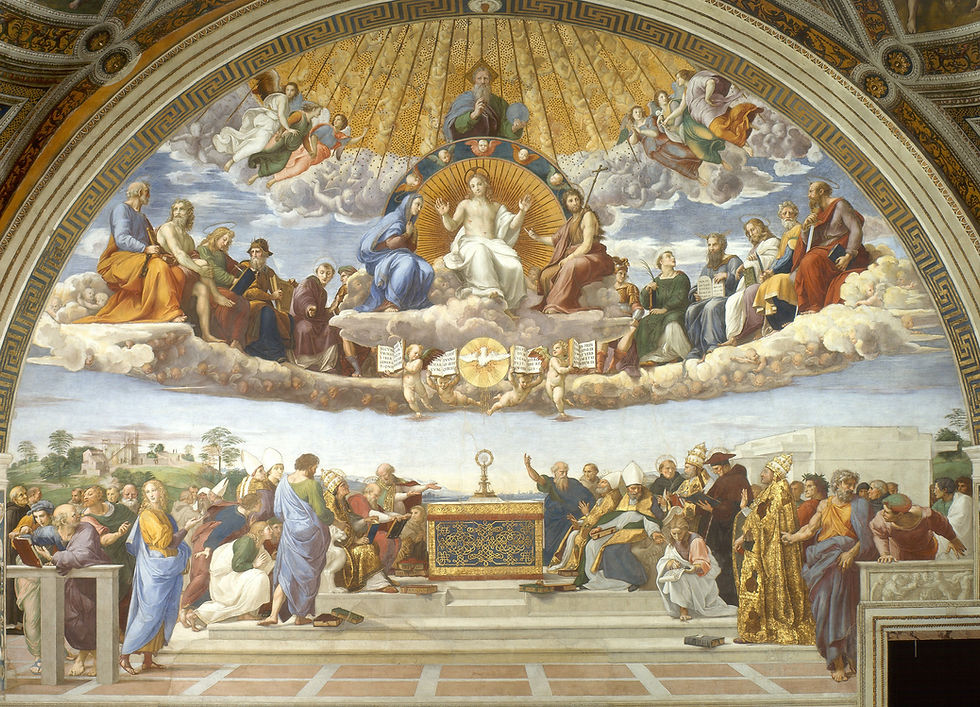
I don’t think it is a coincidence that during these times, we celebrate today’s Solemnity. While the emphasis of the feast (and the rationale for it) is the Real Presence of Our Lord’s Body and Blood in the Eucharist, it is worth pointing out that it is meaningless if we actually do not speak of the Lord as having a body in the first place. He is the God who experienced what it means to be born, to be a needy child, to respond to “the call of nature,” to weep and laugh, to eat and drink, and to go through joy and suffering. It is a body that received wounds and breathed its last in the name of love, and it is a body that was given new life, to be shared with those who are close to Him.
It is this experience of becoming a body that in fact, makes us see that our bodies have value in the eyes of God.
It is not a coincidence that around this time, a lot of us have read or are still reading and reflecting on Pope Leo’s Magnifica Humanitas (MH), and he emphasized that the difference between AI systems and our own humanity are largely connected to our “embodied subjectivities” (see MH #99). In other words, we do not merely process information and produce answers to questions. We are people who grow, who learn from mistakes, who feel our own limitations and suffer from them, who suffer out of the suffering of others.
We learn things after having felt the joy of affirmation, the sadness that comes with failures, and triumph of success after having surpassed our known limits. And all of these are expressed and felt intimately by our embodied selves.
I may go on and on about how our supposed “ideals” only become true when it becomes part of our body’s language and inhabiting the world, but it boils down to a single point: we are redeemed as embodied people.
Christ’s life as a human person gave dignity to our embodied existence, which is part of who we are. The words of the Holy Father, one that is based on Our Lord’s incarnation, reminds us of the sacredness of the body.
Far from a “puritan” interpretation in such a way that the body always has to be disciplined, to be suppressed, to give way for the mind and the spirit, the sacredness of the body implies that even our expressions of our emotions, our desires, and our hopes are valuable and worth considering! And in a way, the hunger and suffering of the poor and the disenfranchised, the wounds and destruction of property brought by war, and the commodification of bodies as products for consumption are all manifestations of evil, perhaps as bad as misinformation and the spreading of fake news.
Our bodies are precious because they manifest who we are and what we are as human beings, and it is the means through which we also follow the Lord and embody our faith in Him.
Perhaps this is what we need as a reminder from the Lord in this celebration of Corpus Christi. But more than that, by the very fact that He shared His life to us through His entire Body and Blood, which we share today, He calls us to do the same.
May our embodied selves be the means to lead others to God by becoming attentive to the material and spiritual needs of others, by giving our own time, resources, gifts, and efforts to show that the love of the Lord is very real, in both its material and spiritual sense. And, being the body of Christ, that is, the Church, may we become witnesses to the Body and Blood we share today, offered and given for us all.


Comments